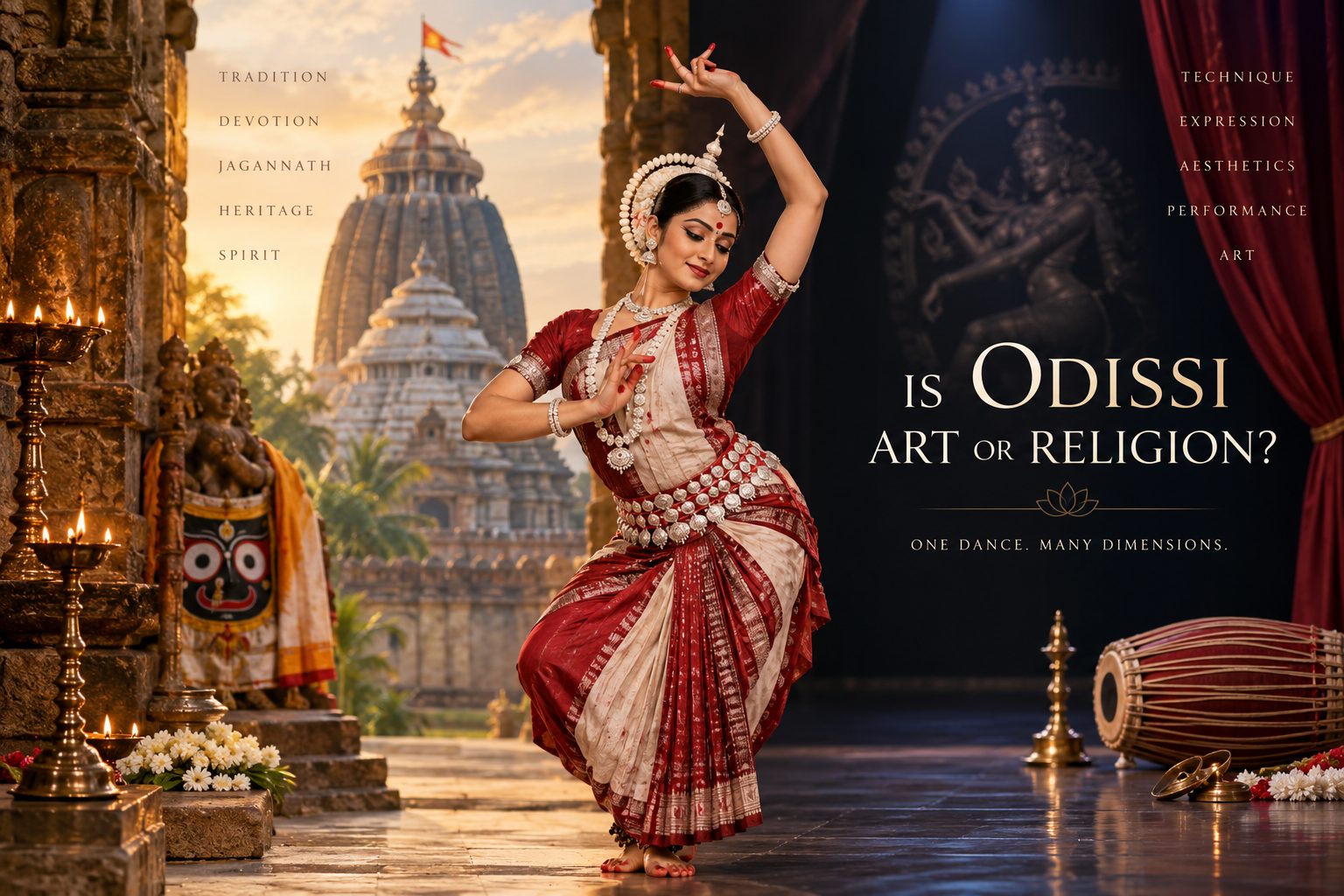
You see the sculptural Chauka, the graceful curves of Tribhanga, intricate footwork, expressive eyes, elaborate hand gestures and the unmistakable sound of the mardala.
But then something becomes apparent.
The dancer is not merely moving.
She may be offering flowers to a deity. She may become Radha searching for Krishna. Her hands may form the lotus, the flute, the moon or the feet of the Divine. Her expression changes from longing to surrender, from joy to devotion.
And suddenly a fascinating question appears:
Is Odissi an art form—or is it a form of religion?
The most accurate answer is:
Odissi is an Indian classical performing art with profound spiritual and devotional roots.
Yet that simple sentence does not tell the whole story.
To truly understand Odissi, we have to travel beyond the modern stage and into the temples, poetry, sculpture and devotional traditions of Odisha.
Odissi Is Officially a Classical Indian Dance
Today, Odissi is recognized and practiced as one of India's classical dance traditions.
India's Sangeet Natak Akademi identifies Odissi as a classical Indian dance originating in Odisha. Modern Odissi is taught in dance institutions, performed at festivals and theatres, studied academically and practiced by dancers around the world.
So, in the straightforward sense of the word, Odissi is an art form.
It has a sophisticated movement vocabulary, musical tradition, rhythmic system, repertoire, technique and aesthetic language.
A dancer spends years developing control over fundamental positions such as Chauka and Tribhanga, learning footwork, rhythm, gestures, expression and eventually the interpretative art of Abhinaya.
But describing Odissi only as a performing art leaves out an enormous part of its identity.
Because much of the tradition that shaped Odissi developed in a world where dance, poetry, beauty and devotion were not necessarily separate things.
Before the Stage, There Was the Sacred
The history of dance in Odisha reaches far into antiquity.
Historical and sculptural evidence demonstrates an old dancing tradition in the region. One frequently discussed example appears in the Udayagiri caves associated with King Kharavela.
Importantly, this reminds us not to oversimplify Odissi's history by claiming that it existed only as temple worship from its beginning.
Historical accounts describe dancing traditions connected at different times with royal courts, religious institutions and temples. Over the centuries, dance became deeply associated with the religious culture of Odisha.
And one relationship would become especially important:
the relationship between dance and Lord Jagannath.
Lord Jagannath and the Sacred World of Odissi
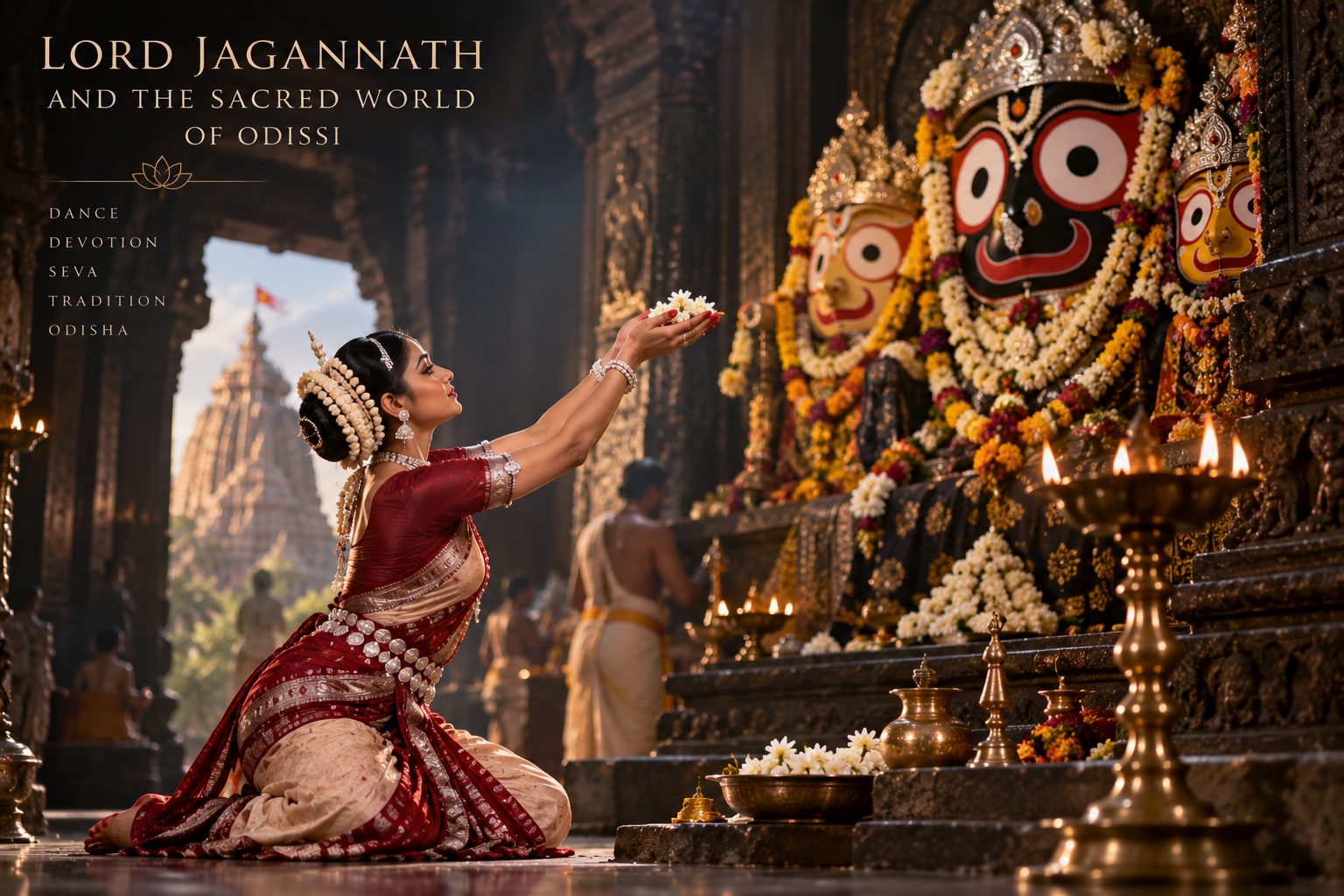
To understand the spiritual identity of Odissi, we must understand something of Odisha's relationship with Lord Jagannath, whose great temple stands at Puri.
Jagannath culture has profoundly influenced Odisha's religious, artistic and cultural landscape.
Within this environment, music and dance were not always regarded simply as entertainment.
They could become seva—service or offering.
This distinction is extremely important.
When a dance is performed as seva, its purpose is fundamentally different from dancing only for an audience.
The deity is not merely the subject of the performance.
The dance itself becomes an offering.
And here we encounter one of the most important traditions in the history of Odissi: the Maharis.
The Mahari Tradition: When Dance Becomes Seva
Maharis were women dedicated to ritual service connected with the temple tradition of Lord Jagannath in Puri.
Dance formed part of this sacred environment.
Unlike the modern theatre, where hundreds of people may watch a dancer under stage lights, the meaning of a ritual performance is centered upon service to the deity.
This gives us one of the clearest reasons why answering “Is Odissi religious?” is complicated.
The Odissi we practice today is a modern classical dance tradition shaped through multiple historical streams.
But among those streams lies a tradition in which dance could literally function as religious service.
The Mahari tradition therefore represents much more than an interesting chapter in dance history.
It reminds us that, within Odissi's cultural ancestry, movement could carry devotional purpose.
Then Came the Gotipuas
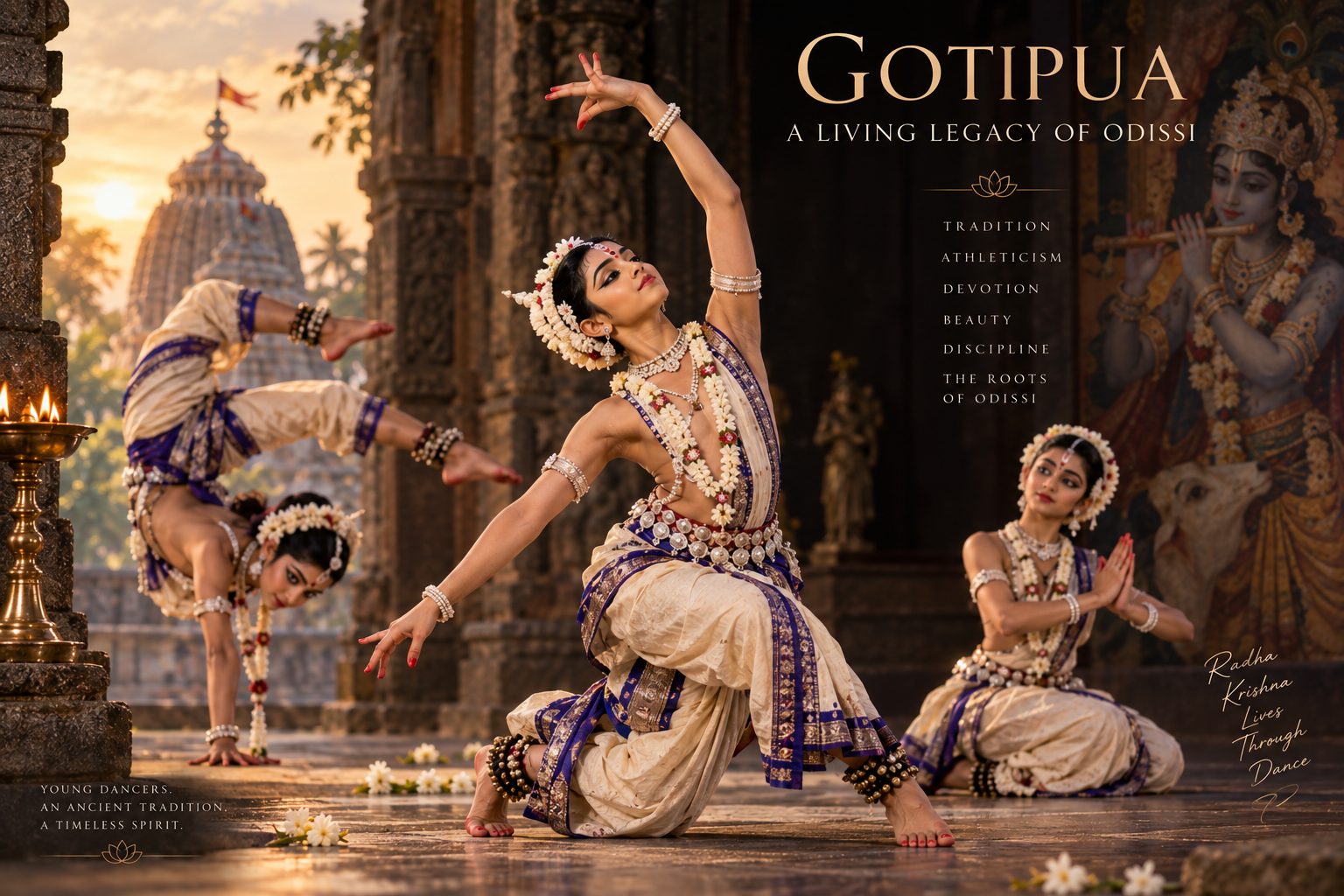
Another major influence upon the development of modern Odissi came through the Gotipua tradition.
Gotipuas are traditionally young male dancers who perform dressed in feminine costume. Their tradition preserved and developed important elements of dance in Odisha, including movement vocabulary that would later influence modern Odissi.
Official Odisha cultural publications describe Gotipua as an important predecessor to the present classical Odissi tradition and note its historical connection with devotional performance.
Gotipua brought its own distinctive qualities, including athleticism and Bandha Nrutya, with demanding poses and formations.
Yet devotion remained deeply present.
The repertoire frequently drew upon Vaishnava poetry and stories of Radha and Krishna.
And that brings us to one of the greatest literary influences upon Odissi.
Jayadeva, the Gita Govinda and the Heart of Odissi Abhinaya
It is almost impossible to explore the devotional dimension of Odissi without encountering the Gita Govinda.
Composed by the 12th-century poet Jayadeva, the Gita Govinda tells of the relationship between Radha and Krishna through extraordinarily rich devotional poetry.
Love, separation, longing, jealousy, reunion and surrender all appear within it.
For an Odissi dancer, however, these are not merely events in a story.
They become bhava—emotional states embodied and communicated through movement and expression.
The dancer may become Radha.
Then Krishna.
Then the sakhi, or friend.
A glance changes the character.
A gesture transforms the space.
The stage becomes Vrindavan.
Odisha's historical literature records the particularly important relationship between the Gita Govinda, Jagannath temple traditions and the development of Odissi's devotional repertoire.
And this is where the boundary between religion and art becomes beautifully difficult to draw.
Radha and Krishna: Romance or Spirituality?
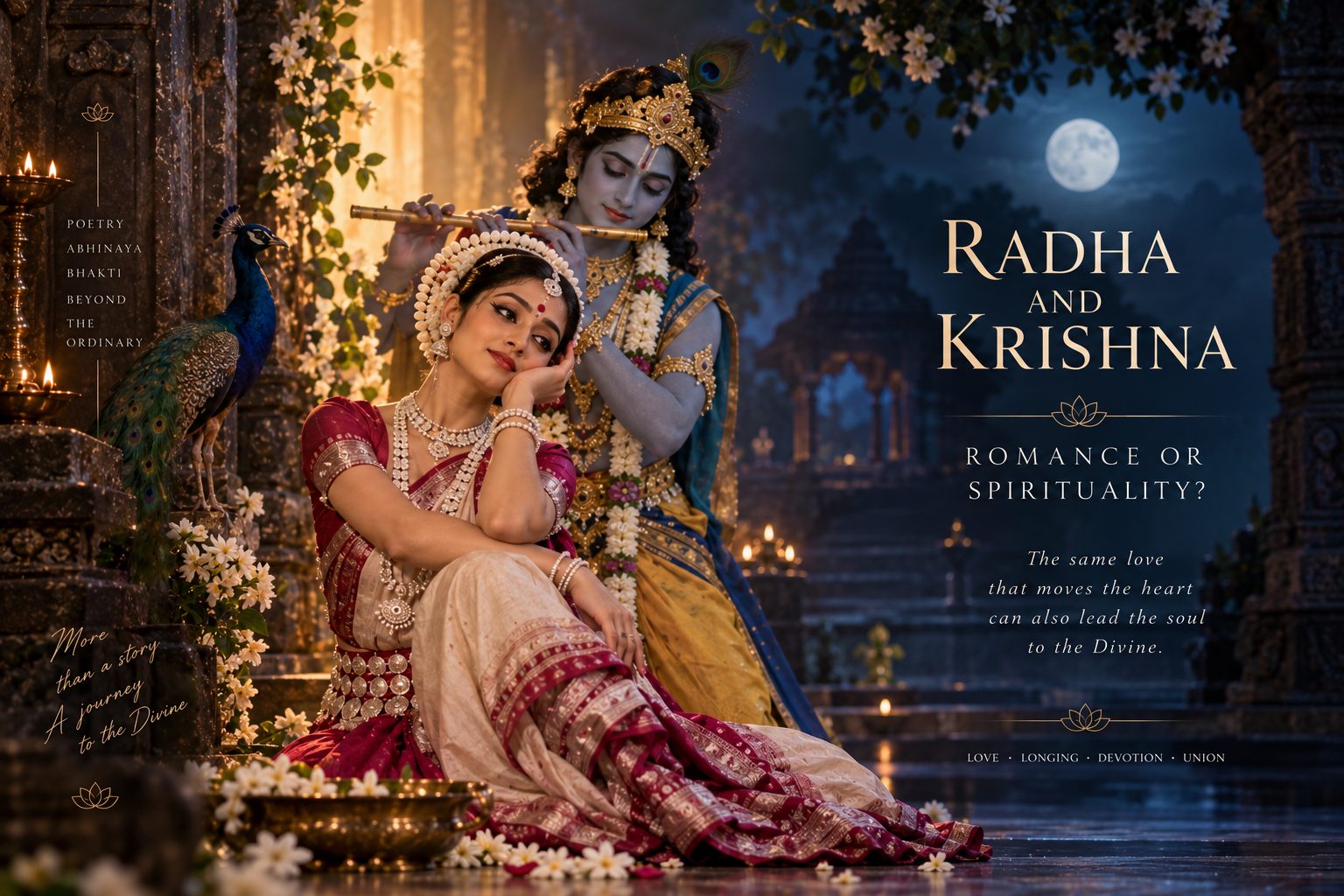
Someone unfamiliar with Indian devotional traditions may watch an Odissi Abhinaya depicting Radha and Krishna and interpret it simply as a romantic story.
There is certainly love.
There is longing.
There is separation.
There is reunion.
But within Bhakti traditions, the relationship between Radha and Krishna carries profound spiritual meaning.
The longing for Krishna can represent something much greater than ordinary romantic desire: the intense longing of the devotee for the Divine.
Separation becomes spiritual yearning.
Union becomes transcendence.
Love becomes devotion.
This is one reason Odissi Abhinaya can operate simultaneously on several levels.
A viewer can appreciate the poetry.
A dancer can explore the emotional psychology.
An artist can admire the dramatic sophistication.
And a devotee may experience the same piece as an expression of Bhakti.
The choreography has not changed.
The relationship of the person experiencing it has.
The Body as a Language
Odissi communicates through far more than steps.
The dancer uses the entire body as an expressive language.
Hands become objects, beings, actions and ideas.
Eyes travel toward an imagined Krishna.
The torso bends.
The head tilts.
The feet establish rhythm.
The face reveals what words cannot.
Through Abhinaya, the dancer does not simply tell the audience that Radha misses Krishna.
The dancer attempts to make the audience experience her longing.
This transformation of emotion into aesthetic experience is fundamental to Indian classical performance.
And it helps explain something important:
Spiritual subject matter does not make Odissi less artistic.
Its spirituality and artistry have developed together.
Mangalacharan: When a Performance Begins With Reverence
The traditional Odissi repertoire makes this relationship particularly visible.
An Odissi recital commonly begins with Mangalacharan, an invocation.
The dancer enters and establishes an atmosphere of reverence. Depending upon the composition and tradition, the dancer may offer salutations to a deity, the guru and the audience.
Already, something interesting has happened.
The audience has not simply been invited to watch a technical demonstration.
The performance has begun through respect, invocation and offering.
This does not mean that every Odissi performance is a religious ceremony.
But it demonstrates how ideas of reverence remain woven into the artistic structure of the tradition.
What About Batu, Pallavi and Moksha?
Not every component of Odissi tells a religious story in the same way.
A Pallavi, for example, emphasizes the unfolding beauty of melody, rhythm and movement. Its complexity develops gradually as the dancer explores the musical composition through pure dance.
Here, the audience may become absorbed in geometry, rhythm, line and movement itself.
Yet even abstract dance exists within the larger aesthetic and philosophical world from which Odissi developed.
At the other end of a traditional recital, Moksha evokes release or liberation.
Even the architecture of an Odissi repertoire can therefore move through different relationships between technique, beauty, expression and transcendence.
Odissi refuses to fit comfortably into the modern idea that something must be either artistic or spiritual.
It can be both.
So, Is Modern Odissi a Religious Practice?
Not necessarily.
This distinction matters.
Learning Odissi today does not automatically mean practicing Hinduism.
Odissi is taught internationally as a classical performing art. Students study posture, rhythm, movement vocabulary, music, choreography, history, literature and expression.
People can study Odissi for many reasons.
- Some approach it as dancers.
- Some as actors.
- Some because they love Indian classical culture.
- Some are fascinated by its sculpture-like physical vocabulary.
- Some feel a strong spiritual connection to it.
- And some are devotees for whom dancing itself becomes an act of worship.
These experiences can coexist.
What should not disappear, however, is understanding.
Do You Have to Be Hindu to Learn Odissi?
No.
A student does not need to convert to Hinduism or personally hold Hindu religious beliefs in order to learn Odissi.
But learning the movements while refusing to learn their cultural meaning would leave an important part of the art unexplored.
- If you perform a story about Radha searching for Krishna, you should know who Radha and Krishna are.
- If you perform a Dashavatara, you should understand the concept being represented.
- If your choreography invokes Jagannath, you should understand why Jagannath is so important to Odisha.
- If you perform a verse from the Gita Govinda, learning what Jayadeva's poetry communicates will transform the quality of your Abhinaya.
Understanding is not the same as conversion.
It is respect for the language of the art you have chosen to study.
Can Odissi Be Performed Without Religious Themes?
Yes.
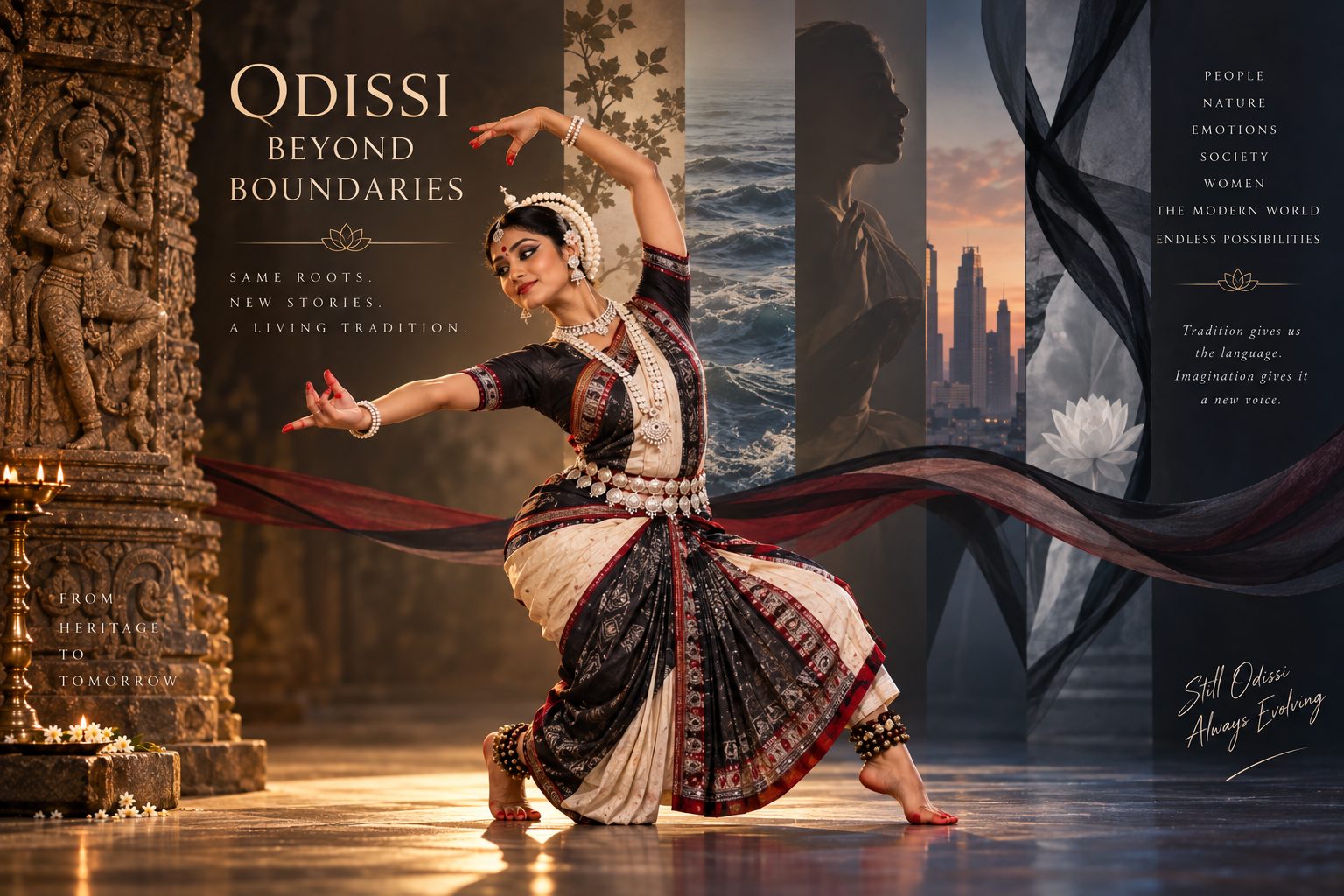
Modern Odissi has continued to evolve, and contemporary choreographers have explored many themes beyond explicitly devotional narratives.
The technique itself—the Chauka, Tribhanga, torso movement, footwork, rhythmic structures, gestures and expressive possibilities—can become a language through which many ideas are explored.
This evolution is part of what keeps a classical tradition alive.
But innovation and historical understanding do not need to be enemies.
A dancer can create something new while knowing where the language came from.
In fact, understanding the tradition often gives an artist more freedom to innovate meaningfully rather than simply borrowing its external appearance.
Odissi Is More Than Beautiful Movement
Perhaps the more interesting question is therefore not:
“Is Odissi art or religion?”
Perhaps it is:
“Why must we force it to be only one?”
Odissi is unquestionably art.
It contains technique, choreography, rhythm, music, literature, theatre, sculpture, costume and extraordinary physical discipline.
But its history also carries devotion.
Jagannath. Radha. Krishna. Temple traditions. Maharis. Gotipuas. Jayadeva. Bhakti. Invocation. Offering.
These are not decorative additions placed around Odissi.
They belong to the cultural world that helped shape it.
For one dancer, Odissi may primarily be an extraordinary classical performing art.
For another, every movement may become an offering to the Divine.
And for another, it may gradually become both.
Perhaps that is one of the most beautiful things about Odissi:
The same gesture can be technique in the classroom, poetry on the stage, and prayer in the heart.
Learning Odissi With Understanding
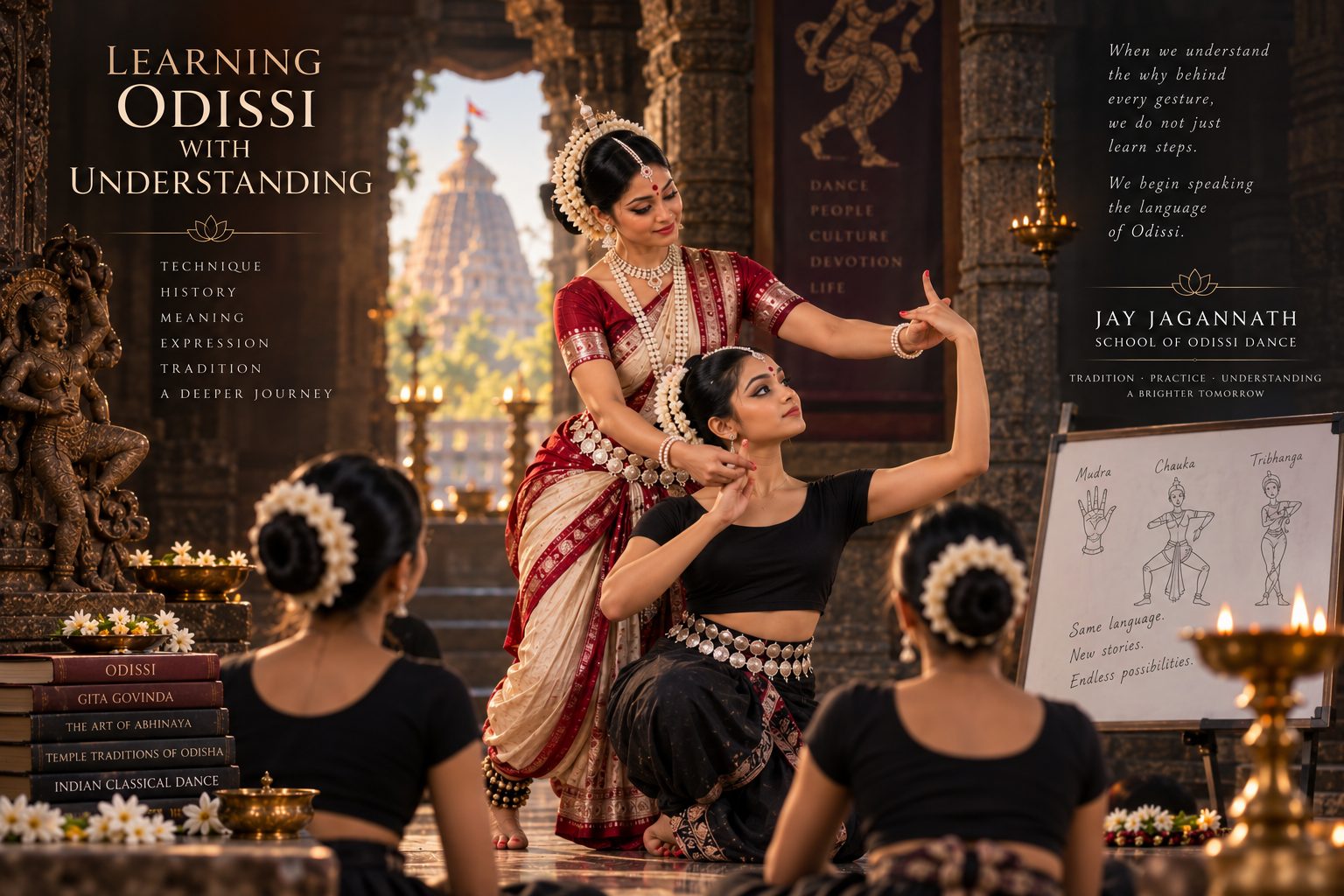
At Jay Jagannath School of Odissi Dance, we believe that learning Odissi means learning more than choreography.
Technique matters.
Precision matters.
Rhythm matters.
But so do history, meaning, expression and respect for the tradition from which this extraordinary art developed.
When a student understands why a gesture is performed—not merely where the fingers go—the movement changes.
When a dancer understands the poetry behind an Abhinaya, expression changes.
And when we understand the centuries of culture carried within the dance, we stop simply reproducing movements.
We begin speaking the language of Odissi.
Frequently Asked Questions About Odissi and Religion
Is Odissi a religious dance?
Odissi is an Indian classical dance with deep historical connections to religious and devotional traditions in Odisha, particularly Jagannath culture and Vaishnava traditions. However, modern Odissi is also practiced internationally as a performing art and is not exclusively a religious practice.
Is Odissi a Hindu dance?
Odissi developed within a cultural environment profoundly influenced by Hindu traditions, and much of its traditional repertoire depicts Hindu deities, poetry and devotional narratives. Calling it simply a “Hindu dance,” however, can obscure its broader history as a sophisticated classical performing art with multiple historical influences.
Do I have to be Hindu to learn Odissi?
No. Students from any religious or non-religious background can study Odissi. Serious study should, however, include respectful learning about the cultural, historical and spiritual context of the repertoire being performed.
Why are Krishna and Radha important in Odissi?
Radha and Krishna appear extensively in Odissi's expressive repertoire, particularly through Vaishnava devotional poetry and works associated with Jayadeva's Gita Govinda. Their relationship provides extraordinarily rich material for exploring love, separation, longing, devotion and spiritual union through Abhinaya.
What is the connection between Lord Jagannath and Odissi?
The Jagannath temple tradition of Puri is an important part of Odissi's historical and devotional background. The Mahari tradition and the performance of devotional poetry, including the Gita Govinda, form part of this complex relationship between temple culture, music, dance and worship in Odisha.
Is Odissi still spiritual today?
It can be. For some practitioners, Odissi remains deeply devotional. Others approach it primarily as classical dance. Its technique can be practiced independently of personal religious belief while its historical repertoire continues to preserve a powerful spiritual vocabulary.
A Final Thought
Art can entertain us.
Art can tell stories.
Art can preserve history.
But sometimes art can also become a way of reaching toward something beyond ourselves.
For centuries, dance in Odisha has existed at the meeting point of body, poetry, rhythm, beauty and devotion.
Modern Odissi has travelled far beyond the temples of Odisha and onto stages around the world.
Yet somewhere inside the Chauka, the Tribhanga, the sound of the mardala and the eyes of the dancer searching for Krishna, echoes of that older world remain.
So—is Odissi art or religion?
Odissi is art.
But within that art lives a profound tradition of devotion.
And sometimes, when movement becomes offering, the line between the two almost disappears.
Learn Odissi With Meaning and Understanding
Join our Odissi classes and learn technique, rhythm and abhinaya together with the history and meaning behind the dance.